South of France Van Trip: Provence, Verdon & Lavender — A 10-Day Itinerary (2026)
Every year, the most-searched van trip question about France is some variation of "how do I do the south of France in a campervan?" The answer people expect — a breezy loop past lavender fields and turquoise gorges — is half right. The answer that's actually useful involves Crit'Air stickers, the specific weeks when lavender actually blooms, which gorge roads your van physically fits on, and why the most famous village in Provence (Gordes) is one of the worst places to take a motorhome.
This is a 10-day route through southern France from Avignon to the Gorges du Verdon and back via the lavender plateau. It's designed for vans and motorhomes between 5.5 m and 7.5 m long. Longer vehicles can do it but need to skip the Verdon's north-bank road (Route des Crêtes) — more on that below.
Table of Contents
- Why Provence is the most-searched van trip in France
- The route at a glance
- Day-by-day itinerary
- When the lavender actually blooms (it's not "all summer")
- Crit'Air zones and low-emission rules you need to know
- Wild camping and overnight rules in Provence
- What it actually costs: a 10-day budget breakdown
- Can your van handle the Verdon gorge roads?
- Travelling with kids on this route
- Practical info: fuel, markets, water, heat
- FAQ
Why Provence Is the Most-Searched Van Trip in France
Provence occupies an unusual position in European van travel: it's simultaneously one of the most beautiful regions on the continent and one of the trickiest to navigate in a large vehicle. The hill villages that make the postcards — Gordes, Roussillon, Bonnieux, Lacoste — were built for donkeys, not motorhomes. The gorge roads are narrow and exposed. The summer heat hits 38–42°C in July and August. And several cities in the region (Marseille, Aix-en-Provence, Avignon, Toulon, Nice) have active or incoming ZFE low-emission zones that restrict older diesel vehicles.
So why does everyone want to do it? Because the landscape is extraordinary and there's nothing else like it in Europe. The lavender plateau of Valensole in late June is a colour that doesn't exist anywhere else. The Gorges du Verdon is the deepest canyon in Europe and the water is an impossible turquoise. The Luberon hill villages are the reason Peter Mayle's books sold millions of copies. The food — even by French standards — is exceptional.
The trick is knowing what to skip (the traffic-choked coast), what to time correctly (the lavender), and which roads to avoid in a van (more than you'd think).
The Route at a Glance
Start/End: Avignon
Shape: Loop (Avignon → Luberon → Verdon Gorge → Lavender Plateau → Avignon)
Total distance: ~450 km
Driving days: 10 (average 45 km/day)
Total driving time: ~9 hours across 10 days
Best months: Mid-June to mid-July (lavender + bearable heat)
Day-by-Day Itinerary
Day 1: Avignon
Aire: Aire de camping-car d'Avignon, Île de la Barthelasse (€13/night, 100 spaces, shuttle to centre)
Avignon is the logical start because it's the first major city south of Lyon with good motorway connections, a TGV station (if you're flying into Paris and renting from there), and a genuinely useful aire on the Île de la Barthelasse — an island in the Rhône, connected by bridge, with a free shuttle to the old city in summer.
The Palais des Papes is the main draw and it's worth the €12 entry — the scale of the place is staggering. It's the largest Gothic palace in Europe, built when the papacy relocated here in the 14th century. The famous bridge (Pont d'Avignon / Pont Saint-Bénézet) is €5 to walk on; honestly, looking at it from the riverbank is just as good and free.
The covered market (Les Halles) runs every morning except Monday. Go Saturday for the full experience — the cheese and olive stalls are reason enough. Buy bread, cheese, olives, and a bottle of Côtes du Rhône for the van. Dinner sorted.
Avignon's ZFE: As of 2025, Avignon has implemented a low-emission zone covering the walled city and surrounding areas. Diesel vehicles rated Crit'Air 4 or worse (broadly, diesel registered before January 2006) are restricted. You must have a Crit'Air sticker displayed. If your van is pre-2006 diesel, park at the aire on the island and take the shuttle in.
Day 2–3: The Luberon — Gordes, Roussillon, Bonnieux
Distance: 60 km
Aire: Aire de Bonnieux (free, 15 spaces, basic) or Aire d'Apt (€5/night, 30 spaces, service area)
The Luberon is the postcard version of Provence — hilltop villages in golden stone, surrounded by cherry orchards and lavender fields. The three villages people want to see are Gordes, Roussillon, and Bonnieux.
Here's the honest advice about Gordes in a van: don't drive into the village. Gordes is the most visited village in Provence. The approach roads are narrow, the car parks are small and have height barriers (usually 2.0–2.3 m), and in summer the traffic backs up on the D2 for kilometres. Park at the bottom of the hill on the D2 or at the car park near the Abbaye de Sénanque (2 km north — the abbey with the famous lavender field in front of it) and walk up. Or view Gordes from the opposite valley — the D15 from Coustellet has the classic panoramic view — and skip the village entirely.
Sénanque Abbey: The lavender field in front of the 12th-century Cistercian abbey is the single most photographed scene in Provence. It blooms from approximately mid-June to late July — see the lavender section below for exact timing. Go before 9 a.m. or after 6 p.m. to avoid tour buses. The abbey is a working monastery; respect the silence.
Roussillon is the ochre village — buildings in every shade of red, orange, and yellow, built directly on ochre quarries. The Sentier des Ocres (€3, 30-minute walk through the old quarries) is genuinely impressive. Roussillon is more van-friendly than Gordes — the car park at the village entrance accepts motorhomes and has reasonable space. Arrive before 10 a.m. in summer.
Bonnieux is the quieter alternative. Less famous than Gordes, equally beautiful, better for vans. The free aire has about 15 spaces on the edge of the village with a view over the Luberon valley. If it's full, the aire in Apt (10 km east) is larger and has a proper service area.
Day 3: Take the D943 east through Apt (Saturday market is one of the largest in Provence — worth timing your trip around it if possible) and continue into the Luberon countryside. The Pont Julien (a 2,000-year-old Roman bridge, still standing, free to visit) is a 5-minute detour off the D108.
Day 4: Manosque and Toward the Verdon
Distance: 60 km
Aire: Aire de Valensole (free, 20 spaces) or Aire de Gréoux-les-Bains (€8/night, 40 spaces, service area)
The drive from the Luberon east toward the Verdon Gorge crosses the transition from cultivated Provence into wilder, emptier territory. Manosque is the last proper town for supplies — there's a Leclerc and an Intermarché, both accessible with large vans. Stock up here.
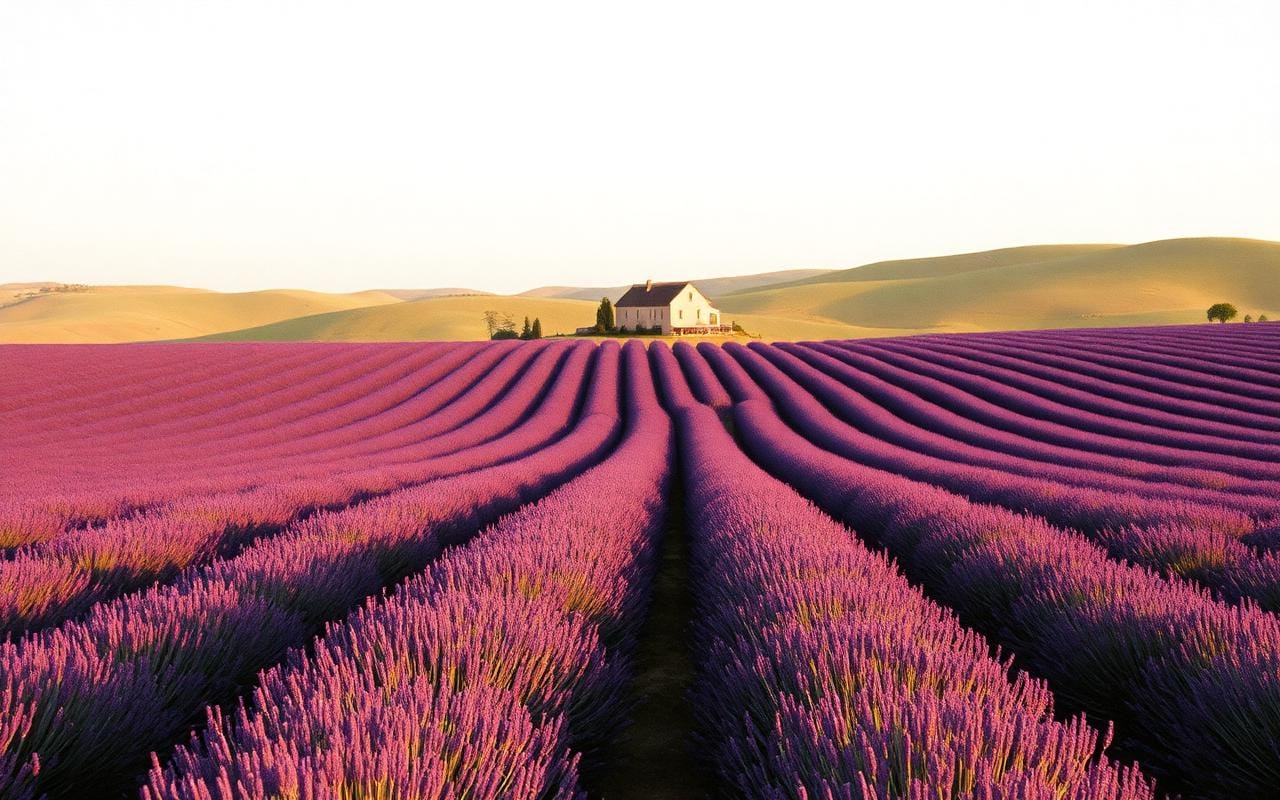
If the lavender is in bloom, take the D6 north from Manosque to the Valensole plateau. This is where the vast commercial lavender fields are — the ones that stretch to the horizon in every direction. Valensole plateau is different from Sénanque's single small field: it's industrial-scale lavender farming across hundreds of hectares, and in late June it's overwhelming.
The aire at Valensole (the village) is basic but free. Gréoux-les-Bains, 15 km south, is a better overnight stop — it's a thermal spa town with a proper aire, a decent market (Thursday mornings), and the river for a swim.
Day 5–6: Gorges du Verdon
Distance: 40 km to the gorge entrance
Aire: Aire de Moustiers-Sainte-Marie (€6/night, 30 spaces, 800 m from village)
The Gorges du Verdon is the centrepiece of this trip and the place where planning matters most. The gorge is 25 km long, up to 700 m deep, and the water is a shade of turquoise that looks photoshopped but isn't. There are two roads along the rim — a north bank road and a south bank road — and they offer very different experiences.
The South Bank (D71, Rive Droite): This is the better-maintained road and the one suitable for all vans and motorhomes. It has proper guardrails, wider sections, designated viewpoints with pull-offs, and the famous Balcons de la Mescla viewpoint. Drive this one clockwise (west to east) for the best views. The full drive from Aiguines to the Pont de l'Artuby takes about 1.5 hours with stops.
The North Bank (D23/D952, Route des Crêtes): This is the more dramatic road and also the more terrifying. Sections are single-lane with no guardrails, blind corners carved into the cliff face, and tunnels with clearance as low as 3.2 m (some even lower at the edges). If your van is under 2.5 m wide and under 3.0 m tall, it's manageable with care. If it's bigger than that, take the south bank and enjoy the view without the stress. This is not a route for nervous drivers in any vehicle.
Moustiers-Sainte-Marie is the obvious base. It's a village wedged into a gap in the cliffs with a gold star suspended on a chain between two rock faces above it (there since the Crusades, supposedly). The ceramics workshops are famous and the village is beautiful. The aire is 800 m below the village — uphill walk, but the setting is worth it. Arrive before noon in summer; it fills fast.
Day 6: Drive the gorge loop. Rent a kayak or an electric boat at the Lac de Sainte-Croix at the western end of the gorge (€15–30/hour). The lake is where the Verdon river opens out and the water goes from turquoise river to turquoise lake. Paddling into the mouth of the gorge from the lake is one of the best experiences in southern France. The beach at Sainte-Croix du Verdon (the village) is swimmable and free.
Alternative stop: If Moustiers is full, the aire at La Palud-sur-Verdon (north bank, €5/night, 20 spaces) is less crowded and closer to the Route des Crêtes and hiking trailheads.
Day 7: Lavender Plateau — Valensole to Sault
Distance: 90 km
Aire: Aire de Sault (free, 20 spaces, edge of village)
This is the longest driving day on the itinerary, but the 90 km crosses the heart of Provence's lavender and passes through some of the emptiest, most beautiful countryside in the region.
From the Verdon, drive west through the Valensole plateau (if you haven't already covered this on Day 4), then north via the D950 through Banon — a tiny fortified village famous for its goat's cheese (Banon AOC, wrapped in chestnut leaves). Buy one. Then continue to Sault, the quiet capital of Provence's lavender country.
Sault is everything Gordes and Roussillon are without the crowds. It sits on a rocky spur above the Nesque valley with lavender fields in every direction. The market (Wednesday morning) is one of the best in Provence — lavender products, local honey, goat's cheese, and Ventoux wine. The aire is free, on the edge of the village, with a view.
Mont Ventoux: If you're a cyclist, the legendary climb starts from Sault — 26 km, 1,200 m of elevation, and the most famous road in cycling. If you're not a cyclist, drive to the summit (1,912 m) for the view — on a clear day you can see the Alps, the Mediterranean, and the Camargue. The road is open approximately May to November. Check conditions before driving — the summit is often windy enough to be genuinely dangerous for high-sided vehicles.
Day 8: The Nesque Gorge and Carpentras
Distance: 45 km
Aire: Aire de Carpentras (free, 20 spaces, near centre)
The Gorges de la Nesque is Provence's secret alternative to the Verdon. It's shorter (about 20 km), less deep, and far less visited. The road (D942) from Sault to Carpentras follows the gorge rim with several viewpoints. The Belvédère du Castelleras is the most dramatic — a 400 m drop straight down. The road is suitable for all vehicles.
Carpentras is a working Provençal town that most tourists drive through on their way somewhere else. This is a mistake in late June and early July, because the Carpentras truffle market (Friday mornings, November to March) and the general market (the same Friday, year-round) are among the best in the region. The old town has a 15th-century synagogue — the oldest still in use in France — and the food is excellent and un-touristy in price.
Day 9: Châteauneuf-du-Pape and the Rhône
Distance: 35 km
Aire: Aire de Châteauneuf-du-Pape (free, 15 spaces, near the château ruins)
The detour to Châteauneuf-du-Pape is obligatory if you drink wine and optional if you don't. The village sits on a hill above the Rhône, dominated by the ruins of the papal summer château, and surrounded on all sides by vineyards producing some of the most expensive wine in France.
The surprise: tasting is free at most domaines, and bottles start at €12–15 for good village-level wine (comparable bottles in a UK shop cost £20–30). The Musée du Vin in the village is a small, free introduction to the appellation. Drive or walk the vineyard roads south toward Bédarrides — the galets (round stones covering the vineyards) are striking and the light in the late afternoon is extraordinary.
The aire is small and fills quickly in season. If full, the aire at Orange (10 km north, free, 30 spaces) is a good alternative — and Orange has one of the best-preserved Roman theatres in the world (€11, worth it).
Day 10: Return to Avignon
Distance: 20 km
Aire: Back to the Île de la Barthelasse if you need a final night
The drive from Châteauneuf-du-Pape back to Avignon is 20 minutes. If you have time, stop at Villeneuve-lès-Avignon on the west bank of the Rhône — the Fort Saint-André has the best panoramic view of the Palais des Papes and the city walls, and it's far less crowded than the city itself.
When the Lavender Actually Blooms
This is the single most common mistake people make when planning this trip. "Lavender in Provence" is not a summer-long event. It's a 4–6 week window that depends on altitude and variety.
Valensole plateau: Mid-June to mid-July. Peak colour: last week of June to first week of July. Harvest begins around July 15 — after that, the fields are cut.
Sénanque Abbey (Gordes): Late June to late July. Slightly later than Valensole because of the altitude.
Sault and the Albion plateau: Early July to early August. The highest-altitude lavender in Provence, and therefore the latest to bloom. The Sault lavender festival is usually the first weekend of August.
Distilleries: Peak distilling season is mid-July to mid-August. If you want to see lavender being processed, time for late July.
The practical advice: If you want to see lavender in full bloom across multiple locations, book your trip for the last week of June through the first two weeks of July. Before June 20, Valensole will be mostly green. After July 20, Valensole will be mostly harvested.
Lavender fields are private farmland. You're allowed to walk along the edges and take photos, but do not walk into the middle of a field, pick lavender, or set up a picnic in someone's crop. Drone flying over fields is increasingly restricted — check local rules.
Crit'Air Zones and Low-Emission Rules
This is the section most blog posts skip, and it's the section that can save you €68–135 in fines.
The following cities on or near this route have active or imminent ZFE (Zone à Faibles Émissions) restrictions:
| City | ZFE active? | Restrictions |
|---|---|---|
| Avignon | Yes (2025) | Crit'Air 4+ restricted |
| Aix-en-Provence | Yes (2023) | Crit'Air 5 banned, Crit'Air 4 restricted progressively |
| Marseille | Yes (2022) | Crit'Air 5 banned, Crit'Air 4+ restricted progressively |
| Toulon | Planned 2025–2026 | Check before travelling |
| Nice | Yes (2022) | Crit'Air 5 banned |
| Montpellier | Yes (2025) | Crit'Air 4+ restricted |
What you need to do:
1. Order a Crit'Air sticker from certificat-air.gouv.fr (€3.70 + postage). This is the only official site — there are dozens of scam websites charging €20–30 for the same sticker.
2. Delivery takes 7–30 days (longer if ordering from outside France). Order before your trip.
3. Display the sticker on your windscreen.
4. If your vehicle is Crit'Air 4 or 5 (diesel registered before 2006, petrol before 2001), do not drive into these city centres. Park outside and take public transport.
This route avoids city centres by design. The Luberon, Verdon, Valensole, and Sault are all rural and have no ZFE restrictions. You only encounter ZFE zones if you detour into Avignon's centre, Aix, or Marseille. If your van is newer than 2006 (diesel) or 2001 (petrol), the sticker is a formality — you just need to have it displayed.
Wild Camping and Overnight Rules in Provence
Provence follows France's national rules — sleeping in your vehicle in a legal parking space is legal; setting up outside is not — but enforcement is tighter here than in most of France, especially in the tourist hotspots.
- Luberon villages (Gordes, Roussillon, Bonnieux, Ménerbes): Most have municipal aires or designated motorhome parking. Overnight parking in regular car parks is restricted in summer. Use the aires.
- Verdon area: The aires at Moustiers and La Palud are your best options. Parking overnight at the gorge viewpoints is technically fine but lonely and exposed. The Lac de Sainte-Croix beach car parks ban overnight parking in summer.
- Lavender fields: Do not park in or adjacent to lavender fields overnight. Farmers are increasingly hostile to vans after years of people driving into fields for Instagram photos.
- Forest tracks: More tolerated in the Luberon and Ventoux forests than near the coast. Leave no trace, no fire (fire risk is extreme — lighting a fire in a forest in summer in Provence can result in a €45,000 fine and imprisonment. This is not an exaggeration.)
Fire season: From June 15 to September 15, access to forests and garrigues (scrubland) is restricted based on daily fire risk assessments. Check prevention-incendie-foret.com before entering any forest area. On red-alert days, forests are physically closed.
What It Actually Costs: A 10-Day Budget Breakdown
For two adults, self-catering with occasional restaurant meals:
| Category | 10-day total | Per day |
|---|---|---|
| Fuel (450 km + local driving, ~600 km total, 10 L/100 km, €1.50/L) | €90 | €9 |
| Aires and parking | €50–80 | €5–8 |
| Food and drink (markets, supermarkets, 3–4 restaurant meals) | €350–450 | €35–45 |
| Tolls | €10–15 | ~€1 |
| Activities (Palais des Papes, kayak rental, Mont Ventoux) | €60–90 | €6–9 |
| Wine (this is Provence — budget for it honestly) | €40–80 | €4–8 |
| Total | €600–815 | €60–81 |
Provence is about 20% more expensive than the Atlantic coast for food and dining. Lavender products make excellent souvenirs and are surprisingly cheap at source (essential oil €5–8 for 10 ml from a distillery, vs €15–20 in a shop).
Can Your Van Handle the Verdon Gorge Roads?
This is the most practically important section of this article.
South bank (D71, Rive Droite):
- Width: two lanes, some narrow sections but all passable
- Height restrictions: none
- Suitable for: all vans and motorhomes up to 8 m
- Guardrails: yes, throughout
- Difficulty: moderate — some hairpins but nothing extreme
North bank — Route des Crêtes (D23):
- Width: single lane in sections, with blind corners
- Height restrictions: tunnels as low as 3.0–3.2 m at the edges (centre clearance may be higher but don't rely on it)
- Suitable for: vans under 2.5 m wide and under 3.0 m tall. Standard camper vans (VW California, Ford Nugget, Mercedes Marco Polo) are fine. Most coachbuilt motorhomes over 6.5 m will struggle.
- Guardrails: minimal in many sections — sheer drops
- Difficulty: high. Not recommended for nervous drivers or first-timers in a motorhome.
The D952 (main road along the north bank, not the Crêtes):
- Suitable for all vehicles
- This is the alternative to the Route des Crêtes if your van is too large
- Good viewpoints but less dramatic than the rim road
Recommendation: If your van is a standard campervan (under 6 m, under 3 m tall), do the south bank on Day 5 and the north bank Route des Crêtes on Day 6. If you're in a coachbuilt motorhome over 6.5 m, do the south bank and skip the Crêtes — the south bank is still spectacular.
Travelling With Kids on This Route
This route works well for families but requires more planning than the Atlantic coast — and the slow-paced hill villages and lavender sunsets make it equally well-suited to couples. The key differences:
Heat management is critical. July and August temperatures in Provence reach 38–42°C. Kids (and adults) wilt. Plan activities for morning and late afternoon. Have a siesta plan — which in a van usually means a shaded aire with the windows open and a battery fan running. The Verdon gorge and the Sault/Ventoux area are cooler (5–8°C less than the Luberon lowlands).
Swimming options are excellent. The Lac de Sainte-Croix is warm, clean, and shallow at the edges — excellent for children. The rivers around Sault and in the Nesque gorge have swimming holes. Public pools (piscines municipales) exist in most towns. The lavender plateau has nothing — plan swimming before or after.
The Luberon villages are not stroller-friendly. Gordes, Roussillon, and Bonnieux are built on steep hills with cobblestone streets. If you have a child under 3, use a carrier, not a pushchair.
Best stops for kids: Lac de Sainte-Croix (swimming, pedal boats, kayaking), the Ochre Trail at Roussillon (kids love the colours), the Sault market (lavender ice cream), and Mont Ventoux summit on a clear day (space, wind, views — kids find it exciting).
Practical Info: Fuel, Markets, Water, Heat
Fuel: Supermarket stations in Apt, Manosque, Carpentras, and Orange are your best options. Diesel €1.45–1.55/L. Rural areas between the Verdon and Sault have very few fuel stations — fill up in Manosque or Riez before entering the gorge area.
Markets (plan your route around these):
| Day | Market | Notes |
|---|---|---|
| Monday | Cavaillon | Melon capital of France |
| Tuesday | Vaison-la-Romaine, Gordes | Gordes is tiny but atmospheric |
| Wednesday | Sault | Lavender products, goat's cheese, honey |
| Thursday | Gréoux-les-Bains, Nyons | Nyons = olive oil capital |
| Friday | Carpentras | One of the biggest in Provence |
| Saturday | Apt, Uzès, Arles | Apt is the best Saturday market on this route |
| Sunday | L'Isle-sur-la-Sorgue | Famous antiques market |
Fresh water: Aires with water taps exist in most stops on this route. The Verdon area is sparser — fill up at Moustiers or Gréoux. Carry at least 2 days of water when entering the gorge section.
Heat management for your van:
- Park in shade whenever possible. Plane trees provide the best shade in Provence — aires under trees fill first for a reason.
- A 12 V or battery-powered fan is not optional in July–August. Ideally two.
- Reflective windscreen covers reduce interior temperature by 10–15°C.
- The Verdon and Ventoux areas are 5–8°C cooler than the Luberon plain. If the heat becomes unbearable, drive up.
- Drink more water than you think you need. 3 litres per person per day minimum.
Mistral wind: Provence's famous north wind blows hard and cold, usually for 3-day cycles, most commonly in spring and autumn. It can reach 100+ km/h. In a van, this means: don't park broadside to the wind, secure everything outside, and enjoy the crystal-clear skies the mistral brings.
FAQ
When is the best time for a Provence van trip?
Mid-June to mid-July for lavender. September for warm weather without crowds or extreme heat. May and October are mild, quiet, and cheaper, but no lavender.
Is the Gorges du Verdon suitable for large motorhomes?
The south bank road (D71) is fine for vehicles up to 8 m. The north bank Route des Crêtes is only suitable for vans under 6 m long and under 3 m tall. The D952 (main north bank road) is fine for all vehicles.
Do I need a Crit'Air sticker?
Yes, if you're entering any city with a ZFE zone (Avignon, Aix, Marseille, Nice, Montpellier). Order from certificat-air.gouv.fr at least 2–4 weeks before your trip. This route mostly avoids cities, but you need the sticker for Avignon.
Can I park overnight at lavender fields?
No. Lavender fields are private farmland. Park at designated aires and drive to the fields during the day.
How hot does it get in Provence in summer?
35–42°C in the lowlands (Luberon, Valensole) in July–August. 28–35°C at higher altitude (Sault, Verdon). Mornings and evenings are pleasant; midday to 4 p.m. is intense.
Is wild camping possible in Provence?
Sleeping in your vehicle in legal parking is allowed. Forest access is restricted during fire season (June 15 – September 15). Wild camping near tourist villages is actively discouraged and sometimes fined. Use aires — there are enough.
How does this route compare to the Atlantic coast?
The Atlantic coast is easier (flat, more aires, better for beginners and families), cheaper, and less crowded. Provence is more dramatic, more culturally dense, and hotter. If it's your first French van trip, start with the Atlantic coast. If you've done that and want something more challenging and more rewarding, Provence is the next step.
Can I combine this route with the Côte d'Azur?
You can, but the coast between Marseille and Nice is congested, expensive, and hostile to vans. If you want Mediterranean swimming, the Verdon lakes are better and free. If you insist on the coast, drive to Cassis (the Calanques are spectacular) and skip the rest.
This itinerary was built by VanRoute AI using verified route data, current ZFE regulations, and real lavender bloom timing for 2026. [Plan your own Provence van trip →](/?prompt=Plan%20a%2010-day%20van%20trip%20through%20Provence%20and%20the%20Gorges%20du%20Verdon%20with%20lavender%20fields)